Tuesday, January 5, 2016

Chocolate Ice Cream Recipe

It's the beginning of June, and I couldn't think of a better post to start off the month with, then this delicious recipe for Chocolate Ice Cream. This is a rich and decadent ice cream, that uses real dark chocolate as well as cocoa powder, and is so smooth and silky, that it simply slides down in your mouth.

click on the images for a bigger view


The ingredients are few and simple:
- 5 egg yolks
- 150 gr (3/4 cups) sugar
- 470 ml (2 cups) milk
- 360 ml (1 1/2 cup) cream
- 40 gr (1/3 cup) cocoa powder
- 150 gr (5 ounces) chocolate (i used dark chocolate with 70% cocoa solids)
- Pinch of salt
- Splosh of rum (optional)


You could use a mixture of dark and milk chocolate. This is really to your taste. Be creative! You can even put while chocolate chips into the finished custard in the end!


Sift your cocoa powder, to remove any lumps that love to hide in it.


In a saucepan put in the milk, cream, and cocoa powder, and stir until it's combined (may take a minute). Cook on medium heat until small bubbles form on the sides. Don't let it come to a boil.


While the milk and cream mixture is heating, combine the sugar, pinch of salt, and eggs. and beat with an electric mixer until pale and creamy, for about 5 minutes.


Pour some of the milk and cream mixture into the eggs and sugar mixture and beat immediately to temper the eggs.


Pour the egg and sugar mixture back into the saucepan and cook on low heat for 5 minutes, or until the custard is cooked and you can run your finger on the back of a wooden spoon that has been dipped into it, and the lines stay separate. That's how you now that the mixture has thickened. 


Strain the finished custard, let it come to room temperature.


Optional: You can add a splosh of rum or rum extract and zest this up! It goes well with chocolate, and also alcohol never completely freezes which gives your ice cream a creamy texture throughout. 


Make sure to chill the inside of your ice cream maker over night as well. Everything needs to be cold to proceed.


Put the custard into your ice cream maker and freeze acording to your manufacturer's instructions (mine took 25 minutes). 

Tip if you don't have an Ice Cream maker: If you don't have an Ice Cream Maker don't be alarmed. You can make this without one (even though It won't taste quite the same). The trick is, once you pour the mixture into the airtight container in the end, take it out of the freezer every 30 minutes for the next 5-6 hours and give it a good stir. That way you'll get rid of the ice crystals that stop the ice cream from being creamy.


Enjoy this lovely and rich ice cream in the summer months. It's a great desert for dinners as well, and you can very the chocolate that goes inside to your liking.


Other Ice Cream Recipes on this Blog are: French Vanilla Ice Cream Recipe and Strawberry Ice Cream Recipe.

Thanks for stopping by and enjoy!
Let me know what you think of this in the comments below.

Monday, January 4, 2016

Dreams of the Orient: Visiting Istanbul

We are going on the road again. And this time, I will be taking you to Turkey, or to be more precise my sister will. This next series that will be uploaded is actually her travel log.

She visited Istanbul, Turkey recently, and made lots of images, that I was editing for her, and we thought about sharing them here as well. There are many things to see and discover in this city, from old mosques, all way to the BosporusThat's why I truly hope you will enjoy the sights and stories that will come.

Part One will be uploaded tomorrow, that's why I wanted to write this post, to let you know. Stay tuned!

click on the image for a bigger view


See you tomorrow!

Sunday, January 3, 2016

Visiting Istanbul [Part 1/3]: The Blue Mosque and Grand Bazaar

Welcome to a newphoto series, that will take us to the south-east of Europe and the south-western tip of Asia: Istanbul. My sister Jasmina made the trip recently and came back with lots of images of this, breathtakingly beautiful place. Even though I didn't make the photos in this series, after editing them for her, I thought that it would be a shame not to share them.
This is a multi part series. Other parts include: 
Part Two: The Topkapi Palace 
Part Three: A Cruise along the Bosporus

click on the images for a bigger view 

In this first part I will show you the Blue Mosque or The Sultan Ahmed Mosque. It is a historic mosque that is popularly known as the Blue Mosque, because of the blue tiles adorning the walls of its interior.

The first image up is actually the Hagia Sophia. From the date of its construction in 537 until 1453, it served as an Eastern Orthodox cathedral and seat of the Patriarchate of Constantinople, except between 1204 and 1261, when it was converted to a Roman Catholic cathedral under the Latin Empire. The building was a mosque from 1453 until 1931. It was then secularized and opened as a museum on 1 February 1935


On the same big square where the Hagia Sofia is located you will also find the entrance to the Blue Mosque. A heavy iron chain hangs in the upper part of the court entrance on the western side. Only the sultan was allowed to enter the court of the mosque on horseback. The chain was put there, so that the sultan had to lower his head every time he entered the court to avoid being hit. This was a symbolic gesture, to ensure the humility of the ruler in the face of the divine.


The Sultan Ahmed Mosque has one main dome, six minarets, and eight secondary domes. The design is the culmination of two centuries of Ottoman mosque development. It incorporates some Byzantine Christian elements of the neighboring Hagia Sophia with traditional Islamic architecture and is considered to be the last great mosque of the classical period. It was quite the undertaking in constructing this mosque.


The court is about as large as the mosque itself and is surrounded by a continuous vaulted arcade.


The coloured glass for the windows was a gift of the Signoria of Venice to the sultan. Most of these coloured windows have by now been replaced by modern versions with little or no artistic merit, as you can see in the lower part of this next image.


At its lower levels and at every pier, the interior of the mosque is lined with more than 20,000 handmade ceramic tiles, made at Iznik (the ancient Nicaea) in more than fifty different tulip designs.


The many lamps inside the mosque were once covered with gold and gems. Among the glass bowls one could find ostrich eggs and crystal balls. All these decorations have been removed or pillaged for museums.


Another popular tourist destination is the Grand Bazaar which is located inside the walled city of Istanbul. The construction of the future Grand Bazaar's core started during the winter of 1455/56, shortly after the Ottoman conquest of Constantinople.


Today the Grand Bazaar is a thriving complex, employing 26,000 people visited by between 250,000 and 400,000 visitors daily, and one of the major landmarks of Istanbul. It must compete with modern shopping malls common in Istanbul.


End of Part One
To be continued...

I hope you all enjoyed part one. The next part called "The Topkapi Palace" will take us to the grand sultan palace, situated above the city of Istanbul, from where you can get a great look at the whole city.

Saturday, January 2, 2016

Visiting Istanbul [Part 2/3]: The Topkapi Palace

We continue our stay in the Orient. In part two I will show you the Topkapi Palace, which is a large palace in Istanbul that was the primary residence of the Ottoman Sultans for approximately 400 years (1465-1856) of their 624-year reign. 
This is a multi part series. Other parts include:

click on the images for a bigger view

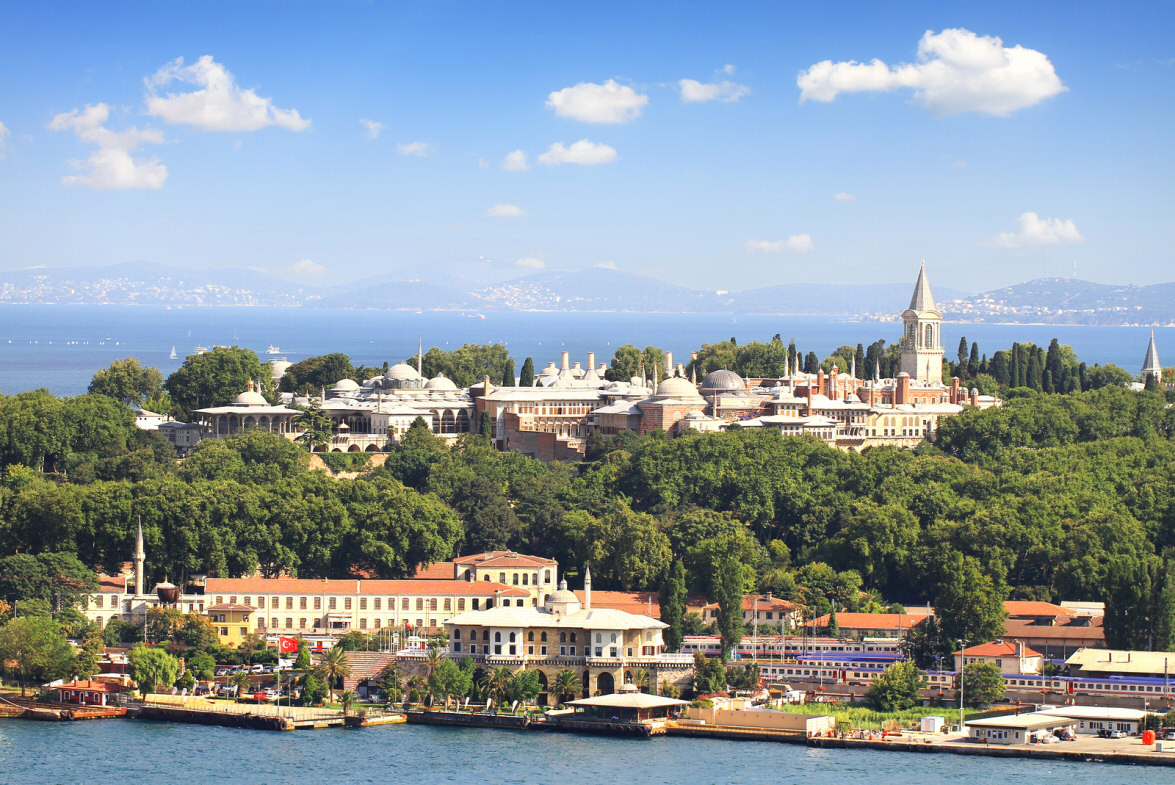
A view from the Topkapi palace on the rest of Istanbul. The palace is located up hill and offers up a great view of the city and the Bosporus.  


The Gate of Felicity is the entrance into the Inner Court, also known as the Third Courtyard, marking the border to the Outer Court or Birûn. The Third Courtyard comprises the private and residential areas of the palace. The gate has a dome supported by lean marble pillars. It represents the presence of the Sultan in the palace.


It also houses dogs, who are sleeping carelessly in the royal gardens :)


The main street leading to the palace is the Byzantine processional Mese avenue, today Divan Yolu (Street of the Council). The Mese was used for imperial processions during the Byzantine and Ottoman era. It leads directly to the Hagia Sophia and takes a turn northwest towards the palace square where the landmark Fountain of Ahmed III stands. 


The palace complex is located on the Seraglio Point, a promontory overlooking the Golden Horn and the Sea of Marmara, with a good view of the Bosporus from many points of the palace. The site is hilly and one of the highest points close to the sea. 


The Topkapi Palace was the main residence of the sultan and his court. It was initially the seat of government as well as the imperial residence. Even though access was strictly regulated, inhabitants of the palace rarely had to venture out since the palace functioned almost as an autonomous entity, a city within a city. 


A strict, ceremonial, codified daily life ensured imperial seclusion from the rest of world. One of the central tenets was the observation of silence in the inner courtyards.


The Audience Chamber, also known as Audience Hall or Chamber of Petitions (Arz Odası), is right behind the Gate of Felicity to hide the view towards the Third Courtyard. This square building is an Ottoman kiosk, surrounded by a colonnade of 22 columns, supporting the large roof with hanging eaves. Inside is the main throne room with a dome and two smaller adjacent rooms.


The viziers came here to present their individual reports to the sultan. Depending on their performance and reports, the sultan showed his pleasure by showering them with gifts and high offices, or in the worst case having them strangled by deaf-mute eunuchs. The chamber was thus a place that officials reporting to the sultan entered without knowing if they would leave it again alive.


Surrounding the whole complex of the First to the Fourth Courtyard are the outer palace gardens. A part of this area that is facing the sea is also known as the Fifth Place.


End of Part Two
To be continued...

In the final part which will be uploaded tomorrow we will take a cruise along the Bosporus, and see the maritime side of Istanbul, as well as various locations hidden along the coastline.